From Baghdad to Kolkata:
Textiles
Ritual Objects, Vessels of Memory
All Baghdadi-Indian event photos courtesy of Maegan Gindi
Blue and Yellow Silk
Ḥallah Cover
Silk embroidery
Kolkata (Calcutta), ca. 1930s–1940s
Embroidered by Ramah Musleah (1907–2006, Rahel’s great-aunt), kindergarten teacher by profession who crafted ritual textiles, including kippot and hallah covers for holidays and life-cycle celebrations.
This cover was used on Rosh Hashanah and the pilgrimage festivals of Shavuot and Sukkot. Unlike the braided hallah common today, Baghdadi Jewish families in Calcutta used small oval-shaped rolls recalling the Temple shewbread on Friday evenings, while Middle Eastern laffa was served on Shabbat day.
The embroidered Hebrew text reads:
תִּזְכּוּ לְשָׁנִים רַבּוֹת
לִכְבוֹד רֹאשׁ הַשָּׁנָה וּלְשָׁלֹשׁ רְגָלִים
May you merit many years.*
In honor of Rosh Hashanah and the three pilgrimage festivals.
*Traditional holiday greeting
White Silk
Ḥallah Cover
Silk embroidery
Kolkata (Calcutta), ca. 1930s–1940s
Embroidered by Ramah Musleah (Rahel’s great-aunt), this hallah cover was used for holidays, as reflected by its traditional holiday greeting.
The embroidered Hebrew text reads:
מוֹעֲדִים לְשִׂמְחָה
[May your] festivals [be occasions] for joy.
Brocaded Velvet Kippah
Velvet and metallic thread
Kolkata (Calcutta), ca. 1940
This kippah was worn by Ezekiel Nissim Musleah (Rahel’s father) at his bar mitzvah on the second day of Sukkot in 1940.
Synagogue Hats
Fabric, velvet, netting, and wire
Kolkata (Calcutta), mid-20th century
These synagogue hats belonged to Ramah Musleah (Rahel’s great-aunt) and were worn during synagogue attendance.
The structured forms, decorative netting, and velvet floral details reflect changing fashions among Baghdadi Jewish women in India during the twentieth century, shaped by Victorian, Middle Eastern, and South Asian styles.
Lace Mantilla
Lace with metallic decoration
Kolkata (Calcutta), early 20th century
This mantilla belonged to Rahel’s grandmother, Flora Moses Musleah (1898–1937), who wore it while lighting the family’s tirya, an oil lamp used for Shabbat.
The lamp was suspended from the ceiling and held seven small glasses filled with oil and wicks.
Handkerchiefs
Printed cotton
Kolkata (Calcutta), ca. 1956–1964
Colorful cotton handkerchiefs in floral and whimsical patterns were used by girls to cover their heads during prayer and synagogue services. In the Baghdadi Jewish community of Calcutta, women and girls covered their heads for prayer regardless of age or marital status.
These handkerchiefs were used by Rahel Musleah and her sisters, Flora and Aliza. One features scenes and words from the English nursery rhyme:
One, Two, Three, Four, Five,
Johnny caught a fish alive,
Why did he let it go?
Because it bit his finger so.
Rahel recalls the excitement of choosing which “hankie” she wanted to wear from a stack of brightly patterned cloths.
Baby’s Outfit
Lace and silk
Kolkata (Calcutta), early–mid 20th century
This infant ensemble includes a lace top, silk undershirt, and bonnet. The embroidered initials “BM” may stand for “Baby Musleah.”
Because no matching bottoms survive, the outfit may have been intended for a brit milah ceremony. If so, the ensemble was never used, as Rahel’s parents had three daughters.
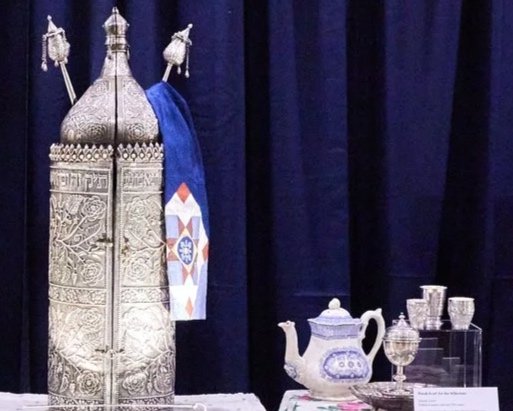
Pesaḥ Scarf for the Afikoman
Printed cotton
Kolkata (Calcutta), early–mid 20th century
This scarf belonged to Masooda Meyer Musleah (Rahel’s great-grandmother) and was used by generations of the Musleah family during the Passover seder. After the middle matzah was broken, the afikoman was wrapped inside the cloth and tied into a bundle resembling the packs carried by the Israelites during the Exodus from Egypt.
The youngest child would sling the bundle over their shoulder and recite Exodus 12:34:
מִשְׁאֲרֹתָם צְרֻרוֹת בְּשִׂמְלֹתָם עַל שִׁכְמָם
Mish-arotam ṣerurot besimlotam ’al shikhmam
Their kneading bowls were bound in their clothes upon their shoulders.
The seder leader would then ask in Baghdadi Judeo-Arabic or Hebrew and the child would respond in kind:
M’nain jeet? (“Where have you come from?”)
:מִמִּצְרָיִם (Mimiṣrayim, “from Egypt.”)
Wain katruhain? (“Where are you going?”)
:לִירוּשָׁלָיִם (Lirushalayim, “to Jerusalem.”)
Wash jwajituk? (“What are your provisions?”)
The child would point to the bundled sack.
For Sephardic Jewish communities that maintain this tradition, the ritual transforms the Exodus story into an embodied memory passed from one generation to the next.